

Not so special relationship
Examining the myth that underpinned post-War ties between the U.S. and UK


This is Deconstructing the Saga, the Story Knight newsletter that unpacks the magic and mechanics behind stories that engage and inspire.
In this issue we explore the myth of the special relationship between the United States and the United Kingdom which has been increasingly called into question since the start of the year.
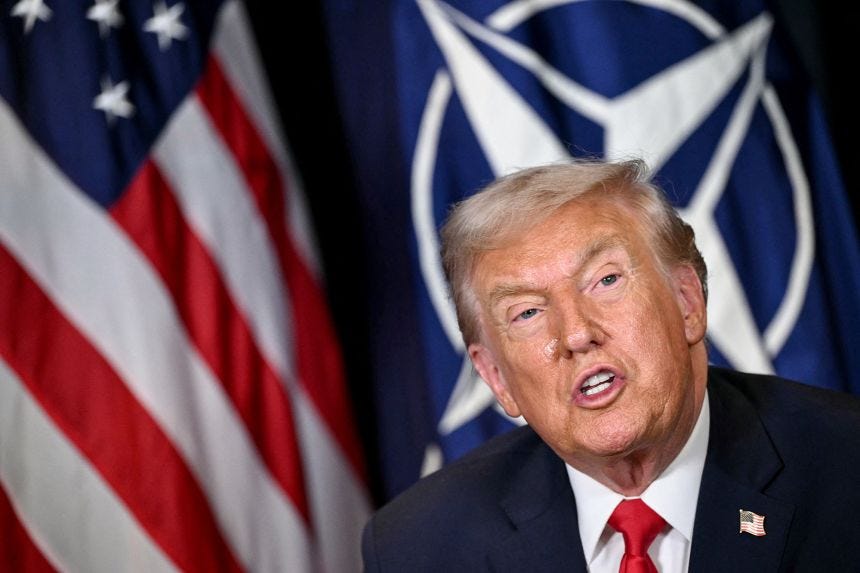
Last week in an interview with Fox News, President Trump made some disparaging comments about NATO troops:
“We’ve never needed them. We have never really asked anything of them. They’ll say they sent some troops to Afghanistan... and they did, they stayed a little back, a little off the front lines.”
This was said of British, Danish, Canadian armed forces who gave the ultimate sacrifice to support the U.S.’ war in Afghanistan.
Was this insult the nail in the coffin of the U.S.-UK special relationship that has endured since the end of World War II?
Not really, because the special relationship never really existed.
It was a cute fiction told by Brits to make themselves feel good about navigating the post-War period without an Empire or much of an influence on global affairs.
The “special relationship" - a term coined by Winston Churchill - is something that British government officials and media obsess over, but something that their American equivalents don’t ever recognise.
To put it bluntly, the relationship was special in the way that a mother tells her toddler that he’s the most special boy in the world after he sticks broccoli up his nose in the most adorable way imaginable and posts the picture to Instagram

The American view of the special relationship
Special relationship is not a term used in American policy circles - unless they’re giving British media a soundbite they want to hear.
In the decade plus since I moved to the U.S, no thinktank wonk I befriended, CFR member I drank with or dinner party conversation on Pennsylvania Avenue ever came close to uttering the term.
In case you think the evidence presented is just anecdotal, consider the cold, hard facts:
Trade: Britain is the US’s 7th largest trading partner
Mexico and Canada trade ~10x more with the US
UK tried to align with U.S. via 2025 Economic Prosperity Deal but still got slapped with tariffs by Trump
Legal: under the 2003 U.S.-UK Extradition Treaty:
U.S. can request the extradition of a British citizen without having to provide prima facie evidence (a “reasonable case”) to a UK court
However, if the UK wants to extradite a U.S. citizen, they must meet the much higher US constitutional standard of “probable cause”
Defense: U.S. has 13 military bases in the UK, the UK has none in the U.S.
Britain’s nuclear warheads require missiles leased from (and stored in) the U.S. to launch
Foreign Affairs: There is no "UK Desk" that holds more weight than the "Europe Desk" at the State Department
U.S. diplomats often view UK's desire for a special carve-out as a diplomatic headache that complicates broader EU strategy
UK Prime Ministers race to be the first to fly to Washington to meet any new U.S. President; new U.S. Presidents get round to 10 Downing Street when it suits their interests
Technology: the UK’s most promising AI companies (like DeepMind) are owned by U.S. giants (Google)
Media: UK media breathlessly covers every presidential visit, every phone call between leaders, every mention of Britain by U.S. officials
Conversely, American media barely notices when the British PM visits
U.S. news is consumed in Britain but the opposite is not true of UK news
Special relationship: a myth that endures
When so much evidence indicates the lack of a special relationship, why is so much ink spilt, airtime filled and fibs fabricated that this special relationship exists?
Because it addresses fundamental human needs for acknowledgement and loss aversion.
First, the myth acknowledges.
Every human on earth wants to be acknowledged in some form or fashion. The brutal reality for Britain was that after World War II it was a weak country far removed from its imperial heyday.
Aligning itself with the emergent power offered the country the opportunity to minimise the sense of loss of empire. The empire was still lost but it didn’t feel so bad if it were attached to the English-speaking, English-founded country that would inherit the mantle of global hegemon from London.
So the reality that Britain was a middling power adrift off the coast of Europe, devastated by war and lacking the imperial resources to reconstruct was subverted by the convenient myth that the UK was now indispensable partner to the new superpower, the United States.
The story works because it feels good to be aligned with the most powerful nation on earth.
Then, the myth protects.
Every human has a sense of loss aversion. It’s why the pain of losing $100 is more deeply felt than the joy of winning $100.
To Britons, aligning the country with the U.S. reduced the pain of losing Empire. It made Britain feel more secure about its highly diminished place in the world after World War II. By helping the U.S. project power in Europe, Britain got to feel important with a permanent seat on the U.N. Security Council, nuclear weapons and more.
Why does this work?
The special relationship is a work of fiction but it has endured for decades because it acknowledges and comforts the audience. It tells them that their concerns are valid and that everything is going to be OK.
Because before a story can move and inspire it must first acknowledge what the audience was worried about to begin with.
Memorable stories are the ones that are relatable and human. There’s nothing more human than acknowledging the struggle your audience is facing and helping them navigate an uncertain period or an upcoming challenge.
On the surface ‘special relationship’ describes diplomatic ties. But peel back a few layers and it describes how a country struggling with its identity tried to keep its mojo.
Thanks for writing this, it clarifies alot, and it makes me wonder what other 'special relationships' are largely myths in the current geopolitical landscape, you're incredibly insightful.